
What is art?
It’s a question that has been asked for as long as humans have been making things—which is to say, for as long as there have been humans.
Forty thousand years ago, someone pressed a hand against a cave wall in what is now Spain or Indonesia and blew pigment around it.
We don’t know why. We don’t know what they called it. We don’t know if they thought they were doing something significant or something ordinary.
We know they did it.
We know we still can’t look at it without feeling something.
That feeling is inconvenient for everyone who has tried to define art since.
Because definition requires a line. And every line that has ever been drawn around art has eventually been crossed, erased, or laughed out of the room—usually by the very people who drew it, once they’d had enough time to forget they drew it.
The Ancient Greeks were clear: art was mimesis—the imitation of nature.
The closer to reality, the better.
Skill was the measure.
Proportion was the standard.
Deviation was error.
This was not an opinion.
This was geometry.
The Renaissance agreed, refined the geometry, and added God to the brief.
Art was the elevation of the divine through the mastery of form. Which was self-evident, obviously, to anyone who had eyes and had looked at a ceiling in Rome.
Then came the Academies—those magnificent, velvet-roped institutions that codified everything the Renaissance had intuited and turned it into examination criteria.
History painting at the top. Landscapes somewhere in the middle. Genre scenes tolerated.
Still life barely. Everything else: not art.
They were not uncertain about this.
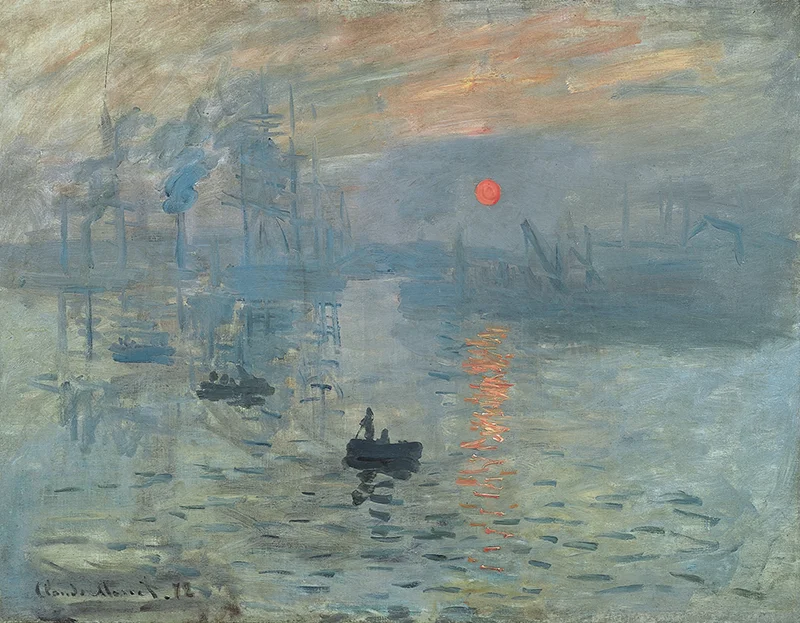
And then a group of painters in Paris started doing something strange with light.
They were painting outdoors—which was already suspicious—and they were painting quickly, which was worse, and they were leaving the brushwork visible, which was essentially a confession of failure.
When they submitted their work to the Salon and were rejected, they held their own exhibition in 1874.
A critic named Louis Leroy attended, looked at a painting of the sun rising over a harbour, and wrote a review dripping with contempt.
He called the painting merely an impression. He meant it as an insult.
They kept the name.
Thirty years later, the Impressionists were in the textbooks.
The Academies were teaching them. And a new group of painters—wilder, more violent with colour, more aggressively strange—were being exhibited in Paris.
A critic looked at their work and called them les fauves—The wild beasts.
They kept that name too.
This is the pattern. The establishment defines.
The rebels transgress.
The establishment recoils, reaches for language sharp enough to wound, and accidentally hands the rebels their identity. A generation passes. The rebels become the establishment. A new group arrives. The cycle restarts with everyone pretending it has never happened before.
Cubism shattered the single viewpoint—why should a painting show you only what you can see from one position, at one moment, with two eyes?
Dada decided that if civilisation could produce the First World War, then civilisation’s art deserved to be mocked into rubble.
Abstract Expressionism said the gesture itself was the content—the act of painting was the painting.
Pop Art said the soup can was as worthy as the Madonna.
Conceptual Art said the idea was the work and the object was optional.
Postmodernism said there were no more original ideas and made that the idea.
Each of these positions was held with complete conviction.
Each looked at what came before and found it insufficient, naïve, or corrupt. Each became, in time, the thing the next movement needed to push against.
And through all of it—the manifesto and the counter-manifesto, the gallery and the anti-gallery, the ‘ism’ and the ‘anti-ism’—the cave paintings kept being cave paintings.
Forty thousand years old and still asking the question that none of the ‘isms’ ever quite answered.
Today we have everything at once.
Painting that looks like photography.
Photography that looks like painting.
Sculpture printed by machines.
Performances that leave no object behind.
Art that exists only as a file, authenticated by a blockchain, owned by someone who cannot hang it on a wall.
AI generating images by the million, each one a synthesis of everything humans have made, producing something that looks like art but carries no life inside it.
And in studios and darkrooms and living rooms and street corners, people are still making things with their hands and their eyes and their specific, unrepeatable experience of being alive—still reaching for something they cannot fully name, still hoping someone else will stand in front of it and feel what they felt when they made it.
So, what the hell is art?